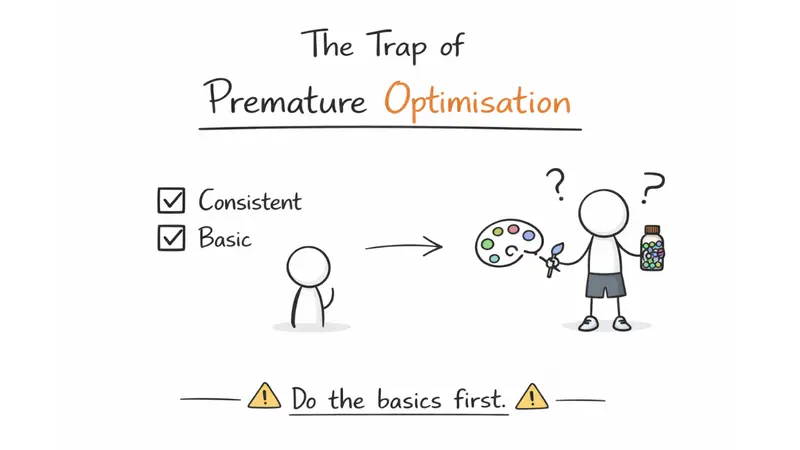
The Trap of Premature Optimisation
Premature Optimisation
Context
During my internship, I was asked to build a small internal dashboard to make adding of AI agents easier. Earlier, these agents were added manually by editing records directly in the database, which is not feasible for a non-technical person.
The dashboard’s job was simple, provide a basic interface so the team wouldn’t need to touch the database directly. So, I built a MVP and it worked. Agents could be added directly to the database, but instead of stopping there and focusing on more important things like defining architecture and the structure of the application, I started polishing things that didn’t matter yet.
What I Started Improving
I started improving the
- UI
- Layout
- Making UX changes
The core workflow was still basic. And this was meant to be an internal tool, but I already started optimising it for the experience.
And later, when a senior dev pointed it out, I realised that what I have been doing is called pre-mature optimisation.
What is Pre-mature Optimisation?
See, pre-mature optimisation is when we start improving or perfecting parts of the system before the fundamentals are even clear.
The issue is not the optimisation itself.
Optimisation is good. It’s valuable.
The issue is timing.
This idea is often associated with Donald Knuth who wrote
Pre-mature optimisation is the root of all evil
This quote is not against optimisation. It warns against doing it before the right moment.
Let me give you another personal example of pre-mature optimisation
Recently my brother started going to the gym.
On the second day, he called me with a question I didn’t expect.
It was not about workouts or about training.
He asked:
“Which supplements should I start taking?”
He had already started thinking about things like
- protein powders
- gym clothes
- supplements
All of this after just a few days in gym.
The funny part was that none of those things were the real problem.
At that stage, the only thing that actually mattered was showing up to the gym regularly, learning basic exercises, building a consistent routine and having a normal meal.
Having supplements or maintaining a sophisticated diet plan is valid, but they are not what determines whether someone succeeds in the beginning.
The real challenge is simply consistency.
What he was doing was a perfect example of pre-mature optimisation. Instead of focusing on the basics, he started thinking about improving the details that only mattered after the basics were already in place.
The point isn’t that optimisation is bad.
The point is that optimising the wrong thing at the wrong time wastes effort.
So, why do we do this?
The thing is this behaviour is not limited to fitness or programming. People do it everywhere. When starting something new, we often focus on:
- tools instead of learning skills
- hacks instead of building habits
- optimisation instead of consistency
because improving feels like progress even when it doesn’t move you closer to the real goal.
How progress usually works
In most of the situations, progress follows a simple order.
- You start with the basics
- You build consistency
- Then you understand the system
- And then you optimise
Optimisation works best only after the foundation is strong enough.
The takeaway
So, the most productive move is
Do the basic and important thing first. Improve it later