DeepSeek vs NVIDIA: Same Active Parameters, Completely Different Models
DeepSeek vs NVIDIA: Same Active Parameters, Completely Different Models
I was browsing AI model benchmarks when I found a comparison that caught my attention.
Two open-weight reasoning models:
DeepSeek V4 Flash - 284B total parameters, 13B active during inference.
NVIDIA Nemotron 3 Super - 120.6B total parameters, 12.7B active during inference.
At inference time, they’re activating almost exactly the same number of parameters. So you might expect somewhat similar performance.
That’s not what happens.
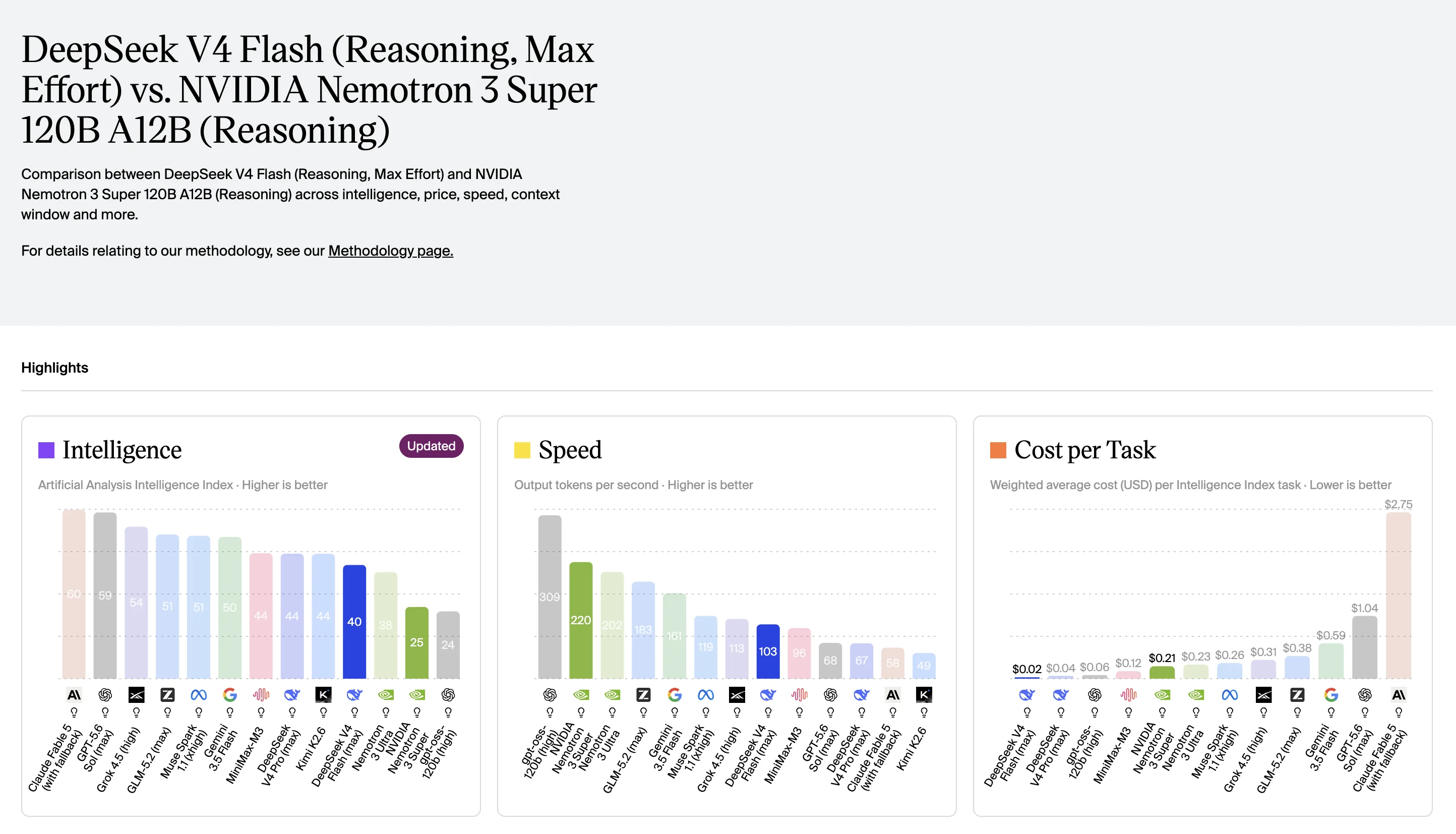
According to Artificial Analysis, DeepSeek V4 Flash scores 40 on its Intelligence Index. Nemotron 3 Super scores 25.
That’s a huge difference.
But then I looked at speed.
DeepSeek generates around 103 tokens per second. Nemotron? 220 tokens per second. More than twice as fast.
And then there’s price. DeepSeek comes in at around $0.06 per million tokens, compared to $0.23 for Nemotron.
So now we have something interesting. One model is significantly more intelligent and cheaper. The other is more than twice as fast. And both activate roughly 13 billion parameters during inference.
Active Parameters Don’t Tell the Whole Story
My first thought was simple - if both models activate around 13 billion parameters per token, why is there such a massive difference in intelligence?
The answer seems to be that the number of active parameters tells you how much of the model is being used, but not how effectively.
Both models use a Mixture of Experts architecture. Instead of activating the entire neural network for every token, an MoE model contains multiple specialized groups of parameters called experts. A routing mechanism decides which experts should handle each token.
Think of it like having a company with hundreds of employees. You don’t ask all 300 people to solve every problem. You send it to the 13 who are supposedly best suited for it.
But having 13 people working on a problem doesn’t tell you how good the result will be. It depends on how skilled they are, how specialized, whether the right people were selected, how well they work together, and how well they were trained in the first place.
Same idea applies here.
DeepSeek has a much larger pool of total parameters (284B vs 120B) from which its routing system can select experts. That doesn’t automatically make it smarter. But it shows why looking at active parameter count alone can be misleading.
Why Is Nemotron Twice as Fast?
This is where it gets interesting.
If DeepSeek is ahead on intelligence, Nemotron has a very obvious advantage elsewhere - raw generation speed.
220 tokens per second versus 103. Its time to first token is slightly lower too - 1.12 seconds compared to 1.24.
For a benchmark, that might look like just another number. For a real product, it can completely change the user experience.
Imagine you’re building a coding autocomplete tool, a voice assistant, a real-time customer support agent, or an interactive application where users expect immediate feedback. In these cases, the smartest model isn’t automatically the best model.
Sometimes a model that is slightly or even significantly less capable but responds twice as fast is the better engineering choice.
That’s something I think gets lost when we reduce every model release to one question: “Is it smarter than GPT/Claude/DeepSeek?”
Intelligence is only one axis. Speed matters. Latency matters. Cost matters. Context matters. Deployment constraints matter.
The Pricing Surprised Me
Usually you expect some kind of trade-off. Better intelligence? Pay more. More speed? Pay more.
But in this comparison, DeepSeek is both more intelligent and cheaper.
DeepSeek V4 Flash: $0.06 per million tokens. Nemotron 3 Super: $0.23 per million tokens.
Of course, token pricing alone doesn’t tell you the actual cost of solving a task. A reasoning model might generate more tokens to reach an answer. A cheaper model that produces worse answers can become more expensive if you constantly retry requests.
This is why cost per successful task is much more interesting than price per million tokens. The cheapest token isn’t necessarily the cheapest answer.
One Million Token Context
Both models support a one-million-token context window. That’s roughly 1,500 A4 pages of text.
For developers, this opens some interesting possibilities. You could feed a model an entire large codebase, hundreds of documents, long legal contracts, or large research archives.
But again, the headline number doesn’t tell the complete story. A model accepting one million tokens and a model effectively reasoning across one million tokens are two different things.
The real question isn’t “How much context can I put in?” It’s “How much of that context can the model actually use reliably?”
The Bigger Lesson
Before looking at these numbers, I would have assumed that two MoE models activating roughly the same number of parameters should have at least somewhat comparable performance.
Clearly, that’s too simplistic.
DeepSeek activates 13B and scores 40. Nemotron activates 12.7B and scores 25. Yet Nemotron generates tokens at more than twice the speed.
Same approximate active parameter count. Completely different strengths.
Parameter count is becoming a less useful way to understand how good an AI model actually is. A model’s real-world performance depends on architecture, routing, training data, post-training, reasoning strategy, inference infrastructure, quantization, and probably dozens of other decisions we don’t see when looking at a leaderboard.
The question shouldn’t be “Which model has more parameters?” or even “Which model has the highest benchmark score?”
The better question is: “Which model has the right combination of intelligence, speed, cost, and reliability for what I’m actually building?”
Because looking at these two models, there isn’t one universal winner. If I wanted stronger reasoning at a lower token price, I’d look at DeepSeek. If raw output speed was critical, Nemotron’s 220 tokens per second would be difficult to ignore.
And if I were actually deploying either one in production? I’d benchmark both on my own tasks before trusting any leaderboard.
Because ultimately, the benchmark that matters most is the one that looks like your actual workload.
Data referenced from the Artificial Analysis comparison of DeepSeek V4 Flash and NVIDIA Nemotron 3 Super 120B A12B.