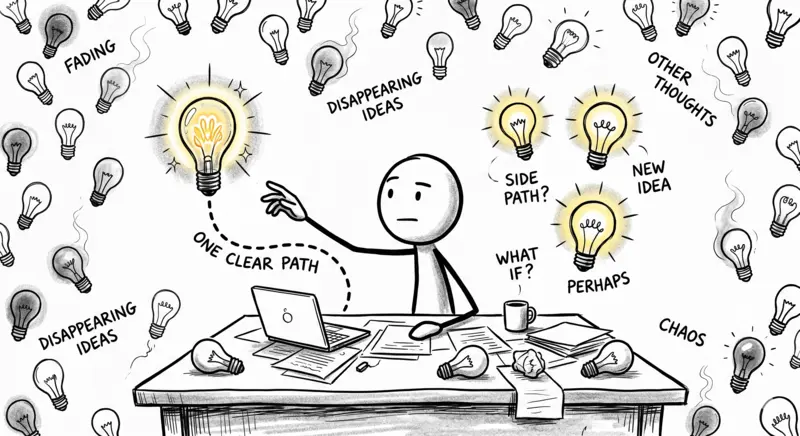
The Curse of Creativity
The Curse of Creativity
It’s 2026 and we are living in a world where thinking is no longer a bottleneck.
Execution isn’t either.
You can wake up to a new idea, open up your laptop and within a few hours - you can build a prototype, generate content and even market it.
This used to take weeks and now it takes hours. On surface it feels like progress.
Earlier ideas were expensive and now they are cheap, almost free.
Here’s the real problem:
We no longer struggle to execute the ideas, we struggle to commit to the ones we decide to move forward with.
What Changed
Earlier when we had an idea, we had no choice but to sit with it and work on it with focus because you had to think on it, you had to struggle.
And that friction made us stick to it.
But now?
The moment something feels hard, we switch. We search for another idea, another tool. We just scatter around.
My Own Struggle
Last month, I had this idea for a SaaS product. Spent a day building it with AI tools. Got the MVP ready.
Then I saw someone on Twitter talking about their AI wrapper making $10K MRR.
Boom. New idea.
Abandoned the SaaS. Started building the wrapper. Got 60% done.
Then another idea hit. And another. And another.
Now I have five half-finished projects and zero shipped products.
If you ask me why this matters,
It’s because depth is what creates results. Ideas and execution alone won’t give you the results you wanted to see. Being focused and sustained on one problem does.
As Steve Jobs said:
Focus is about saying NO
But today saying NO is harder than ever because AI keeps giving you a lot more YES.
It shows you more possibilities, more opportunities and more what ifs.
And this kills your ability to dive deep into the problem.
The Curse
This is what I call:
The Curse of Creativity
When the ability to create becomes so accessible that you don’t value what you create.
And when you don’t value what you create, you don’t stick with it.
Earlier this was an ordered process:
Idea → Effort → Commitment → Result
Now it’s just:
Idea → Execute → New idea → Abandon → Repeat
The Fun Part
I asked AI to build me a todo app yesterday. It did it in 3 minutes.
Did I use it? No.
I asked it to build a better one with more features. Got it in 5 minutes.
Did I use that either? Also no.
I’m now on version 4 of my “perfect” todo app, and I’m still using sticky notes on my desk.
That’s the curse in action.
Why This Matters
What makes this dangerous isn’t that ideas are easy or execution is fast. It’s that you’re constantly being pulled away from depth without even realising it.
Every new possibility feels rational. Every switch feels justified.
But nothing meaningful is built that way.
At some point, you have to accept that most of your ideas don’t deserve to be built - not because they’re bad, but because you can’t build all of them well.
The cost of saying yes to everything is that nothing gets the time it needs to become real.
The Real Skill
So the shift isn’t about finding better ideas or better tools. It’s about developing the ability to:
- Stay when it stops being exciting
- Continue when there’s no novelty left
- Keep working on something even when you’re no longer sure it will work
Because that phase - the boring, uncertain, repetitive - is where almost everyone leaves.
And that’s exactly why it’s the only place where results come from.
If creativity is now infinite, then discipline is the real constraint.
And the people who learn to operate within that constraint - who can ignore the noise, commit to one path, and see it through - are the ones who will actually get what they started for.
Not because they had better ideas.
But because they stayed.
The Ultimate Irony
We have more creative power than any generation before us.
And we’re probably shipping less meaningful work because of it.
The tool that gives us unlimited creation is the same tool that prevents us from creating anything that lasts.
That’s not progress. That’s the curse.